

 Assoc. Prof. Dr Rūta Vosyliūtė. VU MF archive.
Contemporary universities are increasingly questioning whether the mere delivery of subject-specific content is sufficient in the study process. An assessment of the competences of newly recruited academic staff conducted by the Department for Educational Competences of the Faculty of Medicine at Vilnius University (VU MF) revealed a clear trend that the traditional approach to lecturer professionalism no longer corresponds to the current realities of higher education.
When assessing a candidate’s competence, emphasis is still often placed on formal criteria, such as the ability to teach using digital tools like Office 365 or MS Teams, and the ability to speak one or two foreign languages. However, the rapidly changing learning environment, growing student expectations, and technological developments, require much broader competences.
Three main areas of competence in higher education
There is no single document in Lithuania that clearly defines the areas of competence required, so each educational institution categorises and interprets them differently. Although educator competences are receiving increasing attention, they are still often understood in a superficial manner. Based on international practice, the recommendations of the Council of Europe, and an analysis of various documents, VU MF has identified three core areas of competences for educators. The development and improvement of these competences are coordinated by the Department for Educational Competences.
The area of general competences includes literacy, multilingualism, digital and technology-related skills, interpersonal skills, learning to learn skills, active citizenship, cultural awareness and expression, and entrepreneurial skills.
The area of pedagogical competences (didactics) includes the design of teaching content and learning environments, the application of teaching methods, student instruction and assessment of learning outcomes, the provision of feedback, support for the improvement of student learning achievements (providing learning support), the evaluation and improvement of study programmes, and the conducting and application of research in the field of education in terms of teaching practice.
The area of management competences includes those related to communication, administration, leadership, and change management.
Educator competence is not a job title
One of the most common myths is that if a person works as a lecturer, they must have educator competences. However, a job title does not equate to competence.
The Procedure for Ensuring the Educational Competences of Academic and Non-Academic Staff at VU MF defines pedagogical competences (didactics) in broad terms. These include the design of teaching content and learning environments, the application of teaching methods, the assessment of student learning outcomes and the provision of feedback, the organisation of learning support, the evaluation and improvement of study programmes, and the conducting and practical application of research in the field of education. Educator competence is therefore often mistakenly equated with the act of teaching itself. However, it actually encompasses a much wider range of activities – from creating learning environments to managing student progress and implementing research-based teaching practices. Without these elements, teaching risks becoming a mere transfer of information rather than genuine education.
General competences are more than “I am proficient in Office 365” or “I know English”
According to the description mentioned above, the area of general competences encompasses literacy, multilingualism, digital and technology-related skills, interpersonal competences, learning to learn skills, active citizenship, cultural awareness, expression and entrepreneurship.
Another common statement in CVs such as “I am proficient in Office 365” or “MS Teams” no longer represents a competitive advantage, but a rather basic level of digital literacy. Contemporary digital competence includes knowledge of virtual learning environments, the application of digital assessment tools, an understanding of the opportunities and limitations associated with artificial intelligence, a critical approach to information sources and data protection, and a number of other aspects.
Language competence is similarly often understood too narrowly. It is not enough to be able to read or speak a foreign language – it is important to be able to teach complex content using clear academic language, communicate in the international academic community, and prepare study material, publications and projects. In the context of health sciences studies, this is becoming the norm rather than the exception.
Why is this important now?
Higher education is undergoing change: student profiles are evolving, technological capabilities have expanded, and expectations are higher. Consequently, educational competences can no longer be treated as a merely formal requirement. They are the basis for the quality of studies, a prerequisite for student satisfaction and achievement, and a component of institutional reputation.
Educational competences are neither a luxury nor a passing trend. They are an essential element of contemporary academic professionalism. If its institutions aim to offer high-quality, internationally competitive study programmes, they must move beyond the assumption that “just teaching” is sufficient.
Today, not only foreign educational institutions but also Vilnius University offer a wide range of professional development opportunities to improve various areas of competence. Participation in such training should be viewed not merely as recommended, but as a necessary step for anyone seeking to move beyond the role of being “just a teacher”.
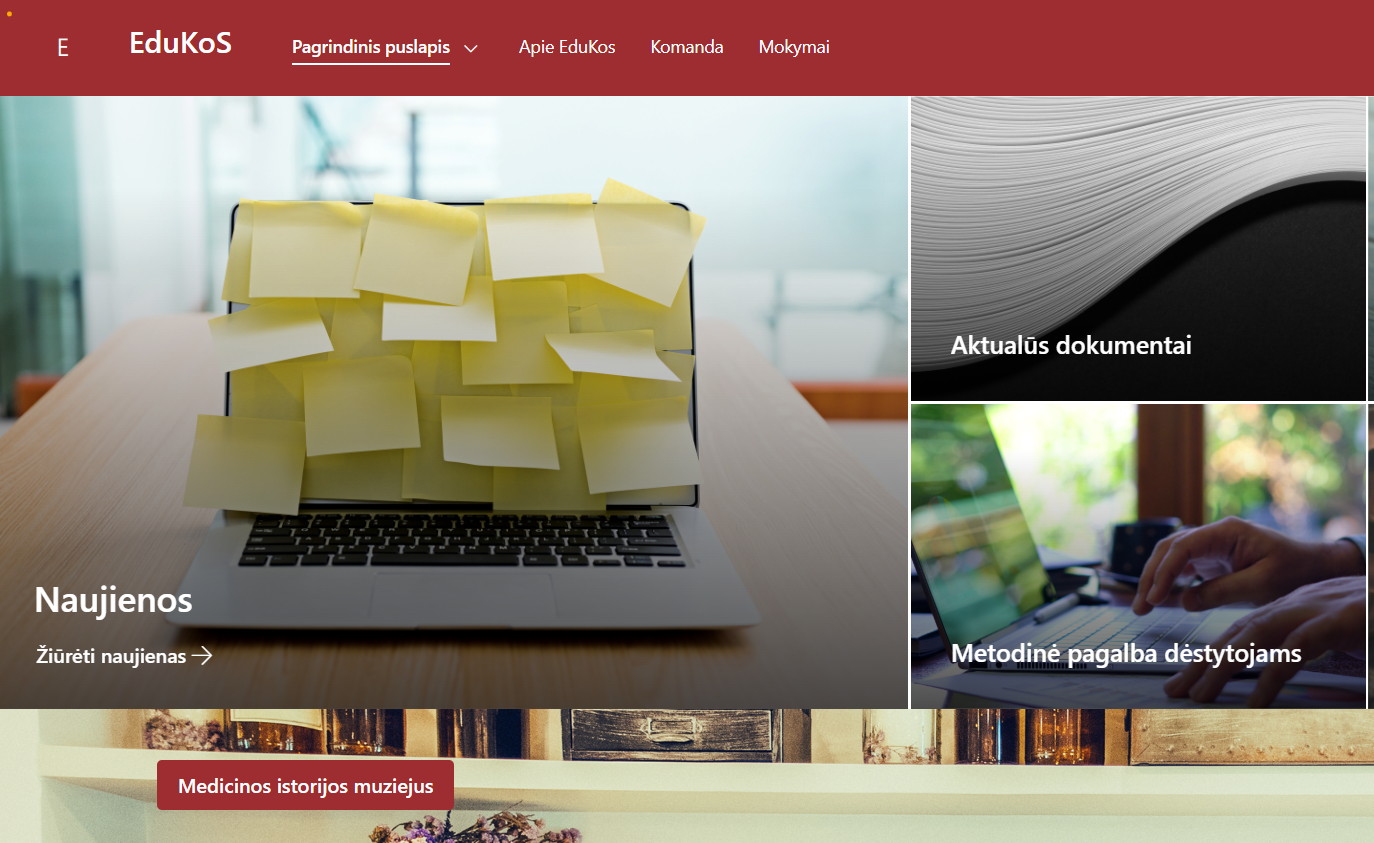 Printscreen of the Edukos website.
Edukos new digital space for improving competences
In response to these developments, Department for Educational Competences of VU MF has developed Edukos, a digital platform for the professional development of academic staff. It provides not only information about upcoming training courses organised by the department, but also relevant documents, information about various methodological resources to support the design of teaching content, learning environments, assessing student learning outcomes, etc.
In the area of competence training, each lecturer can find information about general, pedagogical and managerial competences. Useful and relevant links are provided for each area of competence. The platform includes links to previous training courses organised by the department. Although Edukos is primarily intended for academic staff, non-academic staff will also find useful information and materials in the training section.
Edukos is designed as an open space for professional development that supports staff in strengthening their competences and becoming agents of change in the community.
If you have any questions or suggestions, please contact us by email:
To join EduKoS, you need to log in the same way you log in to other university platforms: email, MS Teams, VUis, etc.
The information was prepared by Assoc. Prof. Dr. Rūta Vosyliūtė, Head of the Department of Educational Competences.