

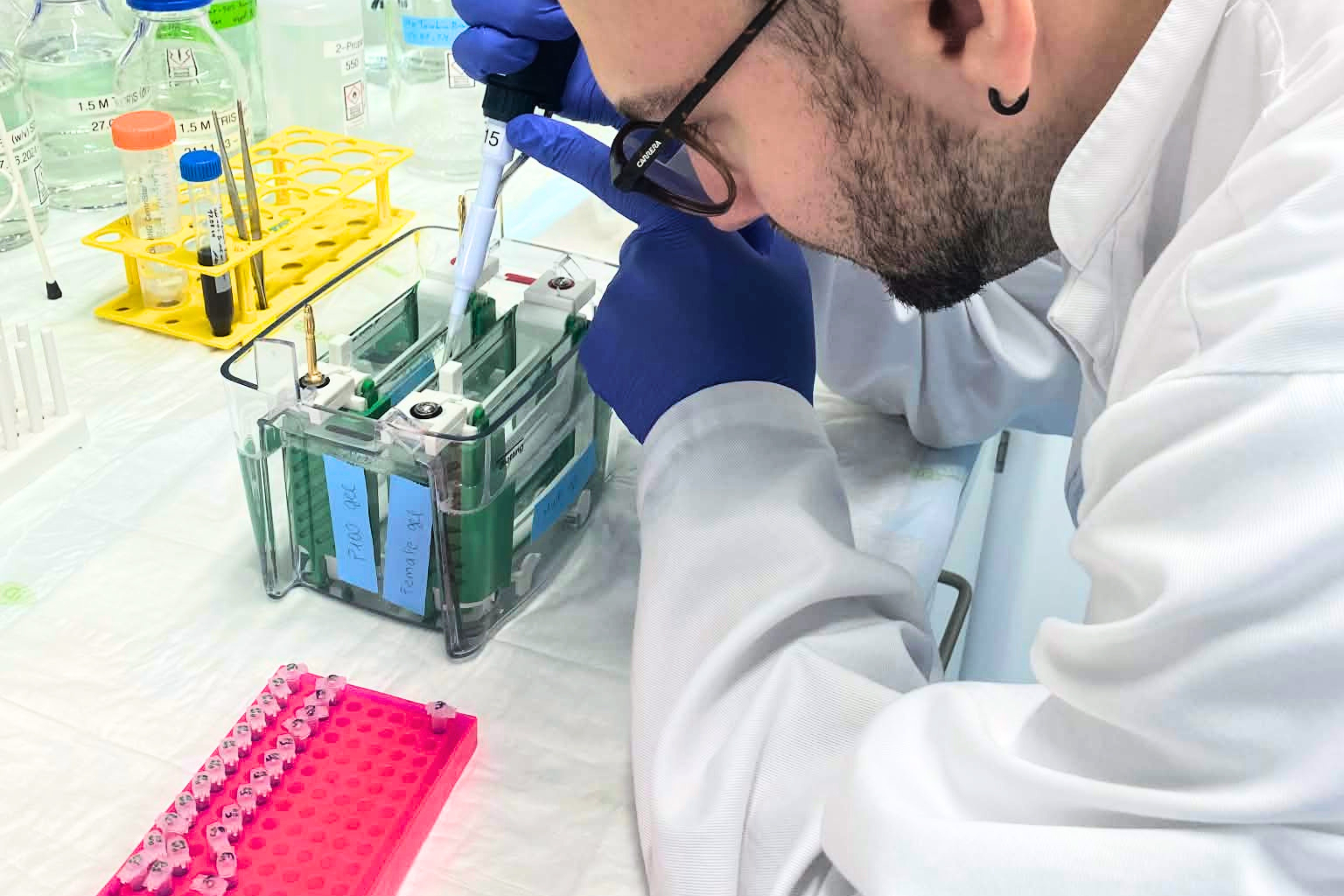
 Moment from the internship / Photo from personal archive
In April 2026, Linas Černiauskas, a doctoral researcher at the Faculty of Medicine of Vilnius University, undertook an internship in the MicroDiagnostics Unit of the Fraunhofer Institute for Cell Therapy and Immunology (Fraunhofer IZI) in Germany. This academic placement marked a highly significant step in developing his scientific competencies in the field of advanced laboratory analysis methods.
According to L. Černiauskas, this internationally recognised research institution stands out for its development of innovative technologies and their application in clinical studies. Therefore, the chosen internship site was closely aligned with the topic of his doctoral dissertation, “Analysis of High-Density Lipoprotein Composition and Function in the Context of Cardiovascular Diseases” (supervised by Prof. Dr Dovilė Karčiauskaitė), as well as its practical applicability.
“The main objective of the internship was to address challenges related to the purification of isolated high-density lipoprotein particle fractions. Training involved the application of size-exclusion chromatography, ultrafiltration, and additional ultracentrifugation in order to further purify the separated particles. These practical activities enabled a deeper understanding of the advantages and limitations of different methods, as well as the possibilities for combining them to adapt methodologies for translational research,” the doctoral researcher explained.
 Fraunhofer Institute for Cell Therapy and Immunology
An equally important component of the internship was mastering advanced analytical methods for particle characterisation. Nanoparticle tracking analysis enabled L. Černiauskas to evaluate the size and concentration of particles in isolated HDL fractions, while additional work using the Western blot technique helped identify specific proteins present within the particles.
“This knowledge is particularly important for accurately differentiating between high- and low-density lipoprotein particles and overlapping extracellular vesicles, as well as for ensuring the maximum possible separation of these particles,” he noted.
Currently, Linas Černiauskas is a Research assistant at the Biomarker Research Laboratory of the Institute of Translational Health Research at the VU Faculty of Medicine, and a Teaching assistant and PhD candidate in the Department of Physiology, Biochemistry, Microbiology and Laboratory Medicine at the Institute of Biomedical Sciences. As the MicroDiagnostics Unit of the Fraunhofer Institute for Cell Therapy and Immunology actively collaborates with various research institutions, biotechnology companies, and start-ups, the internship provided him with a unique opportunity to engage with interdisciplinary projects and the innovation development process. This experience not only broadened his professional perspective but also enhanced his und erstanding of how fundamental research is translated into practical and clinical settings.
The internship was funded under the Research Council of Lithuania measure “Funding of research visits”. The aim of this funding is to provide doctoral students with opportunities to improve their scientific qualifications by participating in international events, to increase their international mobility, and to promote the international dissemination of Lithuanian research outcomes.