

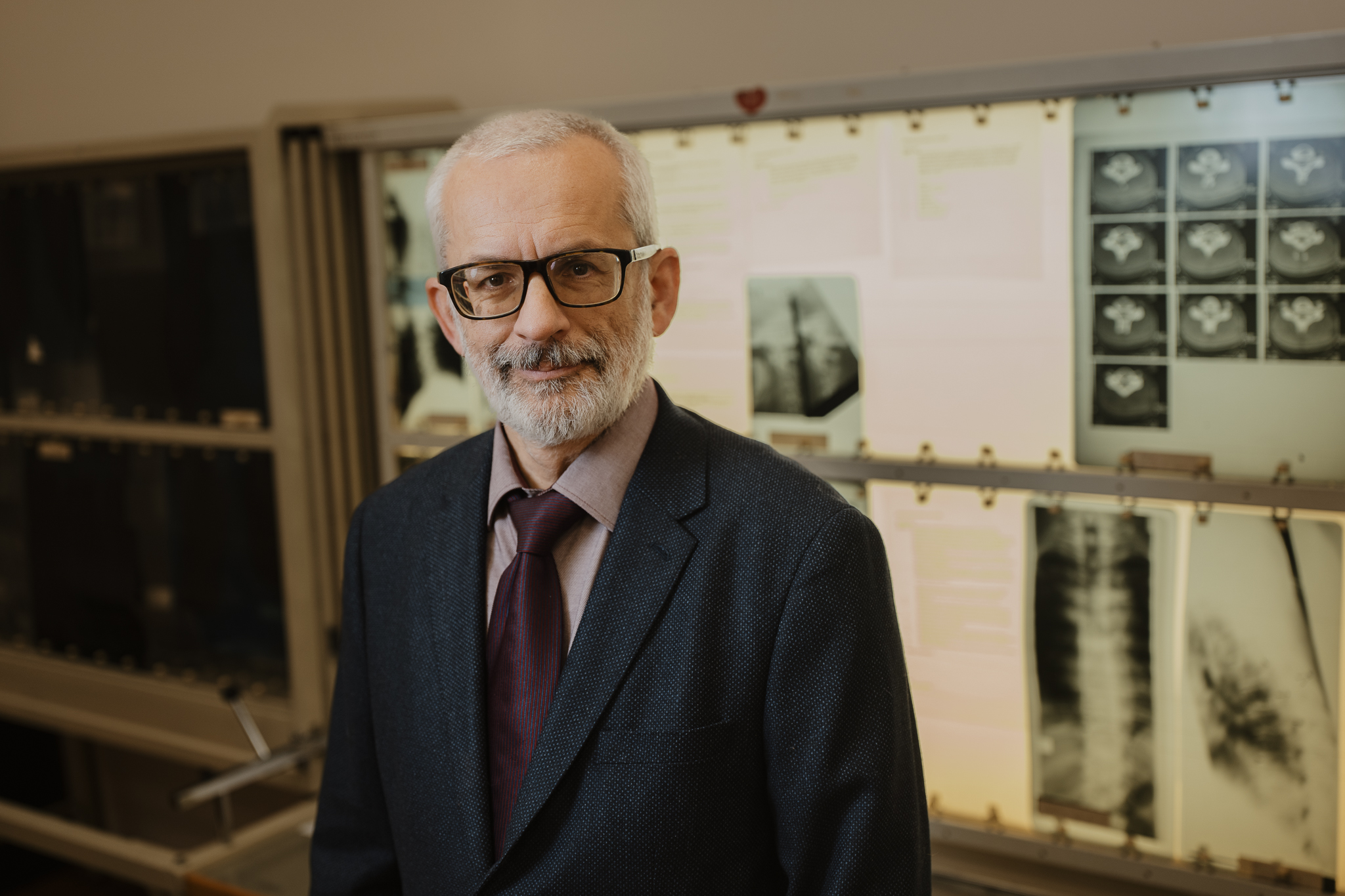
 Assoc. Prof. Dr Arūnas Barkus / Ugnius Bagdonavičius photo
“One of the main principles that I adhere to is that there should be no communication walls between the student and the lecturer. Even considering the existing hierarchy, communication must be based on mutual respect and not cause isolation,” says Assoc. Prof. Dr Arūnas Barkus, who was elected as the best lecturer in 2025. On this occasion, we talk to the associate professor about what is most important in communication between a lecturer and a student and how generations of lecturers and students are changing.
– How did you decide to become a lecturer, what was your path to that?
– I was probably in my 3rd or 4th year of study, when I already had thoughts that I would prefer not clinical work with patients, but pedagogical activity. I saw how wonderfully my now former lecturers worked with students, how they loved them. I myself was very pleased to communicate with the lecturers. At that time, I began to look into areas where future work might not necessarily be clinical. I was interested in pathology, for some time I headed the student scientific society, the pathology club. Then everything unexpectedly turned out in such a way that several new positions appeared in the current Department of Anatomy, Histology and Anthropology. So, after graduating, I immediately got into this department and became a lecturer. In the sixth year I had received several offers from clinicians to go to the Department of Internal Medicine and the Research Institute of Experimental and Clinical Medicine, but I had already made up my mind and had an appointment.
– What do you think are your personal and professional qualities that students like? What values do you follow as a lecturer?
– First of all, this question should probably be addressed to the students – how do they see and evaluate me. I feel a little myself and know from feedback that my communication style impresses students the most. One of the main principles that I adhere to is that there should be no communication walls between the student and the teacher. Even considering the existing hierarchy, communication must be based on mutual respect and not cause isolation. The teacher must respect the student – after all, the student is learning and trying to achieve the same, and maybe even one day surpass his teacher. Of course, the boundaries of academic ethics and familiarity cannot be crossed, but the atmosphere during lectures must be friendly. Another requirement that I set for myself is that practice cannot become stress for the student. And if there is a lecture during which there is less direct contact, I have a principle that the material must be presented schematically, simply, structured and logically. Students really notice and appreciate this. I am trying to fight the established belief that in medical science you need to memorize a lot – no, maybe you need to learn certain information and terms by heart, but I try to explain most of the material in such a way that students can imagine and understand everything in principle.
I have also heard unofficial feedback that my lectures can be compared to a stand-up show. Indeed, I can include a lot of humor into lectures, but I can only do this during live meetings, not during distance lectures.
– What do you like most about your work as a teacher? What motivates you?
– I probably like communicating with students the most. I love asking students questions and making them think – when they find and remember the answer, I am glad that I managed to achieve my goal: to teach them to extract information from memory. They have to record and store information in their brains on their own, I can not help them here, but I can help them extract the necessary information by providing associations and descriptions.
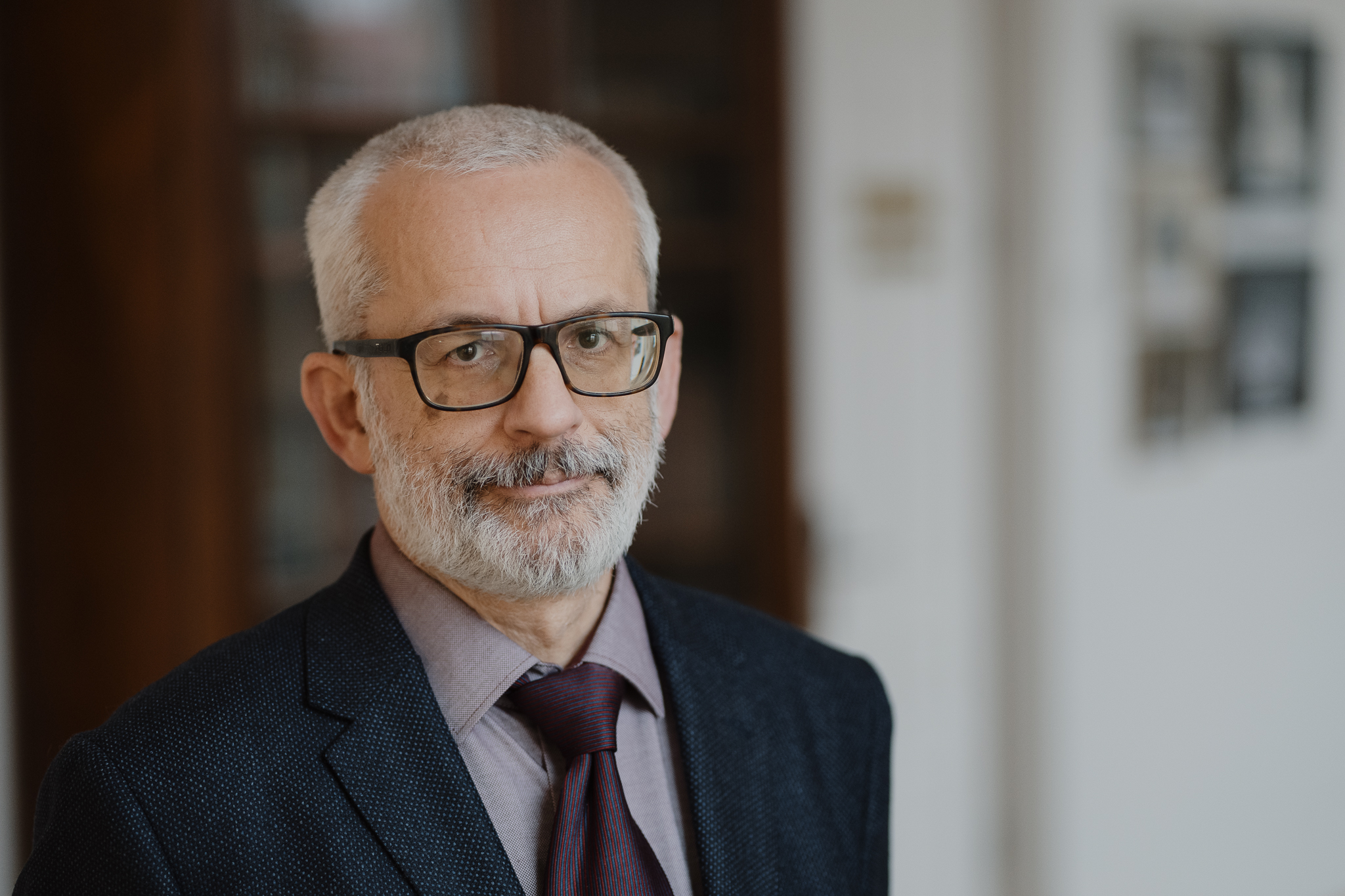 Assoc. Prof. Dr Arūnas Barkus / Ugnius Bagdonavičius photo
– What has changed since you were a student yourself? What are students like today?
– I observe some changes between my generation and the current generation of students. The challenges are not related to people's personal characteristics, but to the knowledge they bring from school. And this is not a trend of the last five years, this problem is already older. When I entered medicine, the decisive exam was physics. Today, physicists who teach first-year doctors, unfortunately, notice that they have to teach and explain such basic things that ten years ago graduates would have already learned at school. Understanding the principles of physics and physical thinking is a very important thing in medicine – all processes in the body occur precisely according to the laws of physics. So, it's a pity, but I observe a falling level of knowledge of physics. I also notice a lack of drawing skills – when analyzing computer tomograms and magnetic resonance images, when you need to create a three-dimensional image from three images, these skills are very much needed, but few students have studied this at school.
Meanwhile, the relationship with students, in my opinion, has not changed: both then and now, the tendency to communicate respectfully and warmly was common in our faculty. We could always come to the lecturer with questions, to talk. However, the availability of information is incomparably better now, so in this sense, it is probably easier for current students to learn. Teachers only have to play the role of a navigator and advisor: to show the student the directions, where to find the right sources in that abundance of information.
– What do you like to do when you are free from teaching and research work? How do you relax, get new ideas and ideas?
– Well, ideas do not necessarily have to be born in your free time, it is best when they are born at work. I like to distance myself from all activities, only, of course, if there are no deadlines and obligations. My family and I have a homestead, where I really like to mow the grass, shovel snow, and split firewood. Last winter I spent a lot of time changing the roofing with a master. So I like simple physical activities and being in the shelter of nature. And passive leisure for me is associated with my curiosity – I am very interested in cinematography, music – progressive rock, heavy rock, German speed metal, power metal, Scandinavian black metal. I like to search for new recordings, listen to them, collect a little. I also like to learn everything about historical events and personalities – every day I find a topic and delve into it, I scroll the Internet until I learn everything about it. This hobby of mine – my interest in history and geography – was already evident during my school days and has remained so to this day.
Assoc. Prof. Dr Arūnas Barkus is a physician, anatomist and anthropologist. He started working at the Department of Anatomy, Histology and Anthropology of the Faculty of Medicine in 1990, and in 2000 he defended his doctoral dissertation in the field of biomedical sciences “Odontoglyphic Characteristics of the Molar Teeth of the Current Lithuanian Population”. In 2008–2015 he worked as the Vice-Dean for General Affairs and Development of the VU Faculty of Medicine, and in 2013 he was awarded the pedagogical title of Associate Professor. He lectures on human anatomy for students of medicine and dentistry programs, neuroanatomy for students of psychology and neurobiology programs, human biology and anthropological dentistry for the dentistry program students. His field of scientific interests is physical anthropology. He participates in anthropological research of current and past Lithuanian populations. Other areas of activity: human anatomy, forensic medicine, statistical applications in biomedical sciences. He is a member of the Lithuanian Morphological Society, Archaeological Society of Lithuania, European Anthropological Association.